NCLA Seeks Court Order for FBI Disclosure of Possible Social Media Censorship Payments
07/07/2026 / By Edison Reed
The New Civil Liberties Alliance (NCLA) filed a motion for summary judgment on June 30 in U.S. District Court for the District of Columbia, asking a judge to compel the FBI and Justice Department to respond to a Freedom of Information Act (FOIA) request filed in January 2023. The request seeks records about payments the FBI allegedly made to social media platforms, including X (formerly Twitter), and other private groups.
According to the motion, the FBI has refused to confirm or deny the existence of records it has previously acknowledged in other settings. The NCLA argues that this refusal violates FOIA’s transparency requirements and leaves unanswered questions about whether taxpayer funds were used to influence content moderation on social media.
Background: FBI’s Prior Admissions and Current Refusal
For years, the FBI has stated publicly that it reimburses X and other providers for costs related to responding to legal process, as required by statute. These admissions are documented in publically available records. However, when NCLA filed its FOIA request seeking details about those payments, the Bureau invoked a FOIA exemption for records “compiled for law enforcement purposes” that could reveal investigative techniques and potentially help someone evade the law. The FBI then used a “Glomar” response, neither confirming nor denying that any responsive records exist.
The NCLA contends that this inconsistency undermines the purpose of FOIA. The payments in question may go beyond routine reimbursement for legal process. If the FBI paid platforms to honor takedown requests or to adjust algorithms and moderation rules, then federal funds may have been used to suppress constitutionally protected speech. As noted in a 155-page ruling by Judge Terry Doughty in a related case, there is “substantial evidence” the government engaged in a large-scale censorship campaign targeting content that questioned official narratives on COVID-19 [9]. The NCLA’s motion builds on those findings by seeking the financial records behind the government’s interactions with social media companies.
Legal Argument: Glomar Response and FOIA Exemption
The FBI’s Glomar response claims that even acknowledging the existence of records would risk exposing law enforcement techniques. But the NCLA argues that the payments are administrative in nature, not investigative, and therefore fall outside the scope of the exemption. Casey Norman, NCLA litigation counsel, stated: “The FBI is effectively saying: ‘We will not search, we will not explain, and we also will not acknowledge the existence of records that we’ve already acknowledged exist.’ That’s … not how FOIA works. If the Bureau used taxpayer money to fund online censorship, the American people deserved to know about it.”
The motion also points to the “Twitter Files,” internal company records released by X owner Elon Musk, which documented how closely federal agencies worked with platform staff to police content. Those files revealed that the U.S. government demanded Twitter suspend more than 250,000 accounts, including those of journalists [4]. In a separate case, FBI and Twitter executives met just four days before the 2022 midterm elections to discuss content moderation policy changes [7]. The NCLA argues that the FBI cannot now claim ignorance of the existence of records when the public record already shows extensive coordination.
Implications: Potential Payments for Censorship
If the court orders the FBI to search for and produce the requested records, the documents could reveal whether the Bureau paid social media platforms to remove content or alter algorithms in ways that favored government narratives. The question is especially significant given the broader pattern of government pressure on social media. In March 2026, the Trump administration signed a consent decree in the Missouri v. Biden case, formally admitting that the federal government pressured platforms to silence protected speech [8]. That decree prohibits future such pressure, but it does not address past payments.
Zhonette Brown, NCLA’s general counsel and senior litigation counsel, said: “The FBI’s nonchalant refusal to adhere to FOIA’s requirements until it is sued defeats the entire purpose for FOIA, but it is all too common. Hopefully the Court wrings some clarity and compliance from the FBI.” The NCLA’s request is narrow—it seeks only records responsive to a specific FOIA filing—but the outcome could set a precedent for how agencies handle requests for information about their interactions with private platforms. Author Mark Dice, in his book “The True Story of Fake News,” discusses how social media platforms are filled with paid influencers and undisclosed advertising, noting that the Federal Trade Commission has cracked down on such practices [3]. The coordination between government and platforms, whether through payments or other means, raises similar concerns about undisclosed influence.
Conclusion: Court to Decide on Disclosure
A federal judge will now rule on the NCLA’s motion, determining whether the FBI must search for and produce responsive records. The case highlights long-standing questions about the extent of federal influence over online speech. No hearing date has been set, according to court records.
The NCLA’s efforts come amid a series of legal battles over government transparency. In 2021, the FDA asked a federal court for 55 years to release documents related to Pfizer’s COVID-19 vaccine [1]. A judge later ordered the FDA to produce the data in eight months. [2]. The NCLA’s current motion reflects a similar push for accountability, asking the court to force a recalcitrant agency to comply with the law.
References
- NaturalNews.com. “FDA asks a federal court to give it 55 YEARS to fully release Pfizer COVID-19 vaccine data.” November 22, 2021.
- Children’s Health Defense. “Judge Gives FDA 8 Months Not 75 Years to Prod.” Michael Nevradakis. January 21, 2024.
- Mark Dice. “The True Story of Fake News How Mainstream Media Manipulates Millions.”
- Children’s Health Defense. “U.S. Government Demanded Twitter Suspend 250,000 accounts, Including Journalists.”
- Cindy Harper. “Motion Asks Judge to Force FBI Disclosure of Potential Twitter Censorship Payments.” Reclaim The Net. July 3, 2026.
- Reclaim The Net. “FBI Wins Court Ruling to Keep Twitter Payments Secret.” February 20, 2026.
- Reclaim The Net. “FBI and Twitter Met on the Eve of the Midterms.” November 4, 2025.
- Reclaim The Net. “Missouri v. Biden Consent Decree: US Government Admits Pressuring Social Media Platforms to Censor Protected Speech.” March 25, 2026.
- Children’s Health Defense. “Citing ‘Orwellian’ Tactics, Federal Judge Orders White House to Stop Censoring Americans’ Social Media Posts.”
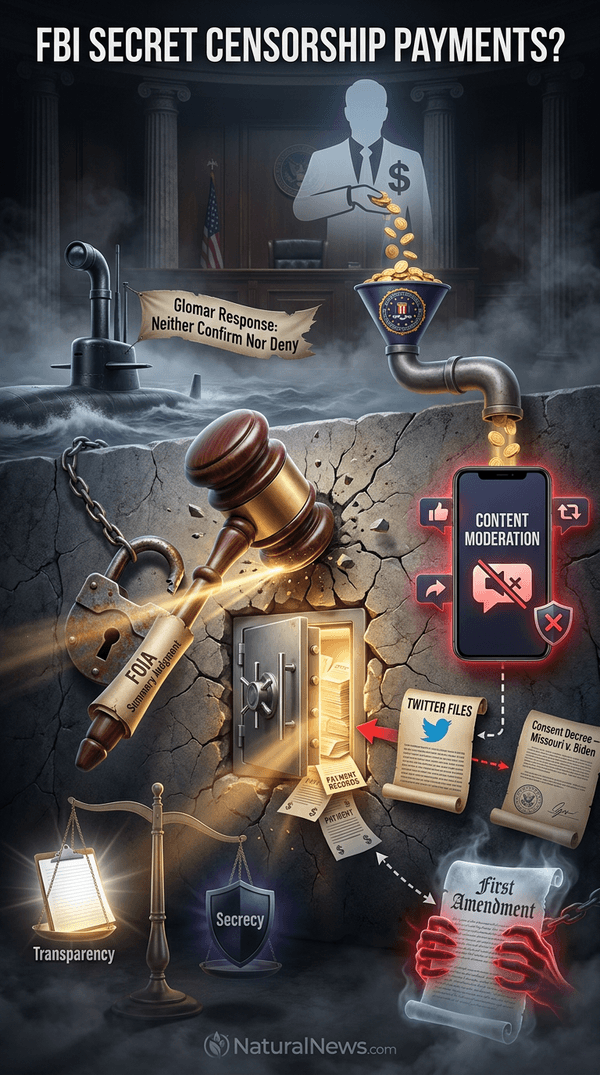
Explainer Infographic
Submit a correction >>
Tagged Under:
big government, Big Tech, Censorship, child protection, collapsifornia, free speech, harmful content, online speech, Parental rights, resist, Social media
This article may contain statements that reflect the opinion of the author
RECENT NEWS & ARTICLES